| BRASILIAN FEDERAL POLICE |
| BRAZILSKA SAVEZNA POLICIJA |
|
|


|
Saveznim ustavom Brazila uspostavljeno je pet različitih policijskih organizacija: federalna policija, federalne patrole autocesta, federalna željeznička policija, državne vojne policije i vatrogasne brigade te državne civilne policije. Nad prve tri ingerencije ima federalna vlada, a ostale su pod upravom saveznih država. Sve su policijske snage dijelovi izvršne vlasti bilo federalnih bilo lokalnih. Glavne su im zadaće održavanje reda i mira. Ukoliko je prekršen federalni zakon, djeluje federalna policija, inače to obavljaju lokalne vlasti. |
||
|
In Brazil, the Federal Constitution establishes five different law enforcement institutions: the Federal Police, the Federal Highway Police, the Federal Railway Police, the State Military Police and Fire Brigade, and the State Civil Police. Of these, the first three are affiliated to federal authorities and the latter two subordinated to state governments. All police institutions are part of the Executive branch of either federal or state government. There are two primary police functions: maintaining order and law enforcement. When criminal offences are committed in violation of federal laws, federal police forces carry out those functions. |
||
|
FEDERAL HIGHWAY POLICE SAVEZNA PROMETNA POLICIJA |
||
|
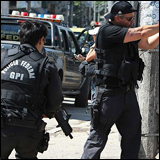
Polícia Rodoviária Federal ili PRF je Savezna prometna policija podređena Ministarstvu pravosuđa. Zadaća im je borba protiv kriminala na brazilskim federalnim cestama i autoputovima. Osim toga bave se i nadzorom prometa te učestvuju u akcijama u gradovima i šumama u suradnji sa ostalim sigurnosnim agencijama. Federalna prometna policija je podređena Nacionalnom odjelu transportne infrastrukture (DNIT). Po novoj organizaciji "patrolmen" pozornik od 1988. godine ne postoji. Pripadnici Savezne prometne policije podijeljeni su u četiri kategorije: agent, operacijski agent, specijalni agent te inspektor. |
||
 |
|
|
| SLEEVE PATCH | ||
| Oznaka za rukav | ||
| The Brazilian Federal Highway Police (Polícia Rodoviária Federal or PRF) is a federal law enforcement agency, subordinate to the Ministry of Justice, whose main function is fighting crime on Brazilian federal roads and highways, as well as monitoring and supervising vehicular traffic, although it has also taken on duties that go beyond its original authority, such as action within Brazilian cities and forests in conjunction with other public safety agencies. It is subordinate to the National Department of Transport Infrastructure (Departamento Nacional de Infra-Estrutura de Transportes or DNIT. The title patrolman no longer exists as of 1998. Members of the PRF are divided into four classes: agent, operational agent, special agent, and inspector. | ||
|
OTHER SERVICES OSTALE SLUŽBE |
||
|
NATIONAL FORCE OF PUBLIC SAFETY NACIONALNA SLUŽBA JAVNE SIGURNOSTI |
||
|
U situacijama ozbiljnijeg narušavanja javnog reda, kada rješavanje situacije nadilazi kapacitete državnih snaga, guverner može zatražiti pomoć Savezne vlade. Za takve situacije je Ministarstvo pravde osnovalo Nacionalne snage javne sigurnosti (Força Nacional de Segurança Pública; FNSP). Ove snage u svojem sastavu imaju specijalno izvježbane pripadnike vojne policije iz raznih država. Njihova obuka i djelovanje je koordinirano od strane Sekretarijata za javnu sigurnost pojedine države i Ministarstva pravde. |
||
 |
||
| NATIONAL SECURITY FORCE | ||
| Snage nacionalne policije | ||
|
In situations of serious disturbance of the public order that exceeds the capacity of the State, the Governors can request assistance from the Federal Government. To work in such situations, the Ministry of Justice has the National Force of Public Safety (Força Nacional de Segurança Pública; FNSP). The FNSP is composed by specially trained officers of the Military Police of different States, in coordination between the Secretary of Public Safety of each State and the Ministry of Justice. |
||
ON TOP
 NA VRH
 |
||