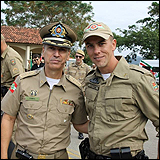
| MILITARY POLICE of SANTA CATARINA |
| VOJNA POLICIJA SANTA KATARINE |


|
|
||
 |
||
 |
 |
 |
 |
||
|
ABOUT BRASILIAN MILITARY & CIVILIAN POLICE O VOJNOJ I CIVILNOJ POLICIJI |
||
|
|
||
|
Vojna policija (Portugalski: Polícia Militar, PM) je naziv za "preventivne" policijske snage, pozornike (u HR temeljna policija). Svaka od saveznih država ima svoj korpus vojne policije koji vrši prevenciju zločina (patroliranje, privođenja i ostale tipične poslove temeljne policije) dok se "civilna policija" bavi detektivskim poslom, forenzikom i kriminalističkim istragama. Ovlasti među tim dvjema policijama variraju od države do države. Na primjer, u saveznoj državi Rio de Janeiro, (gdje je vojna policija na lošem glasu) ovlasti su joj strogo ograničene. Iako ime doslovno znači vojna policija, nalaze se pod upravom guvernera, a ne federalnih institucija. |
||
|
The Military Police (Portuguese: Polícia Militar, or PM) is the name of the preventive state police forces in Brazil. Each of the states of Brazil has their own corps of military police, which carries out preventive police duties, while the "Civil Police" carries out detective work, forensics and criminal investigation. The exact balance of the policing workload varies from state to state. For instance, in the State of Rio de Janeiro, where the military police has a particularly bad reputation, its duties are much more limited. Although the name literally means military police, implying a gendarmerie, under normal circumstances these forces are under the authority of the state governor, as opposed to being a national institution, as is the norm in the Gendarmerie model. |
||
ON TOP
 NA VRH