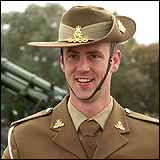
| AUSTRALIAN ARMY CAP BADGES |
| AUSTRALSKA KoV ZNAČKE ZA KAPE |
|
|


| THE AUSTRALIAN ARMY CAP BADGE OZNAKA ZA KAPE AUSTRALSKE VOJSKE | ||
|
Najpoznatija kapa australske vojske je "Slouch hat", čuveni šešir sa uzdignutim lijevim obodom. Na njemu se nose dva znaka. Postoji nekoliko pravila od kojih ću ovdje navesti samo neka. Na prednjem dijelu šešira se nosi oznaka regimente, a na podignutom dijelu korpusa. Ako se na prednjem dijelu nosi znak korpusa, onda na savijenom lijevom obodu stoji "izlazeće sunce" znak australske vojske. Svi korpusi i regimente imaju i platnene oznake na ramenima (da li na obadva da ili na lijevom ili desnom ovisi o tradiciji jedinice) a na epoletama se nose i metalne oznake "inicijali" jedinice, npr. MP za Military Police, vojnu policiju ili RNSWR za Royal New South Wales Regiment. |
||
 |
||
|
The main headwear in the Australian Army is the Slouch hat, that is a broad brimmed hat with the left side turned up. There are two badges worn on the hat, on the front is the Regimental badge and on the turned up side is worn the Corps badge, for example the Royal Australian Regiment badge would be worn on the front of the hat and the Infantry Corps badge worn on the turned up brim and if the unit you belonged was a Corps , for example say the Medical Corps, then this badge would be worn on the front of the hat and the Rising sun badge of the Australian Army would be worn on the turned up brim. Also worn on the right side of the hat on the hat band is a colour flash, this also identifies the wearers unit. Also all Corps and Regiments have a coloured lanyard which is worn on one shoulder, which shoulder it is worn on depends on the traditions of the unit and finally on the shoulder epaulettes there is worn a metal badge(Staybrite) which spells out the units name for example RNSWR is worn by members of the Royal New South Wales Regiment or RAA is worn by Royal Australian Artillary. |
||
|
ROYAL INFANTRY CORPS KRALJEVSKI PJEŠADIJSKI KORPUS |
||
|
Kraljevski australski korpus (Royal Australian Infantry Corps) u svom sastavu ima sve regimente australske vojske. Nastavni centar je u Singleton-u, Novi južni Wales. Korpus je aktivan od 23. 11. 1948. godine i u svom sastavu ima jednu regularnu regimentu (sastavljenu od osam bataljona) i trinaest regimenti sa rezervnim sastavom. Moto Korpusa je "dužnost je prva", a službene koračnice su: brza "El Alamein" i spora "Pješadijska pjesma". |
||
 |
|
|
|
The Royal Australian Infantry Corps (RA Inf) is the parent corps for all infantry regiments of the Australian Army. Major components of the RA Inf include the various battalions of the Royl Australian Regiment and Army Reserve regiments eg. Royal New South Wales Regiment. The Infantry School is located at Singleton, New South Wales. Corps is active from 23. November 1948 till present. Size of the Corps is 1 regular Regiment (8 battalions) and 13 Reserve Regiments. Corps motto is "duty first", and marches are quick "El Alamein" and slow "Infantry song". |
||
|
ROYAL AUSTRALIAN REGIMENT KRALJEVSKA AUSTRALSKA REGIMENTA |
||
| Prije formiranja ove regimente Australija nije imala stalnu profesionalnu vojsku. Iako je RAR novo formirana jedinica, to nije totalni prekid sa prošlošću, jer je ona formirana od vojnika koji su učestvovali u 2. svjetskom ratu, a naslijedila je i tradicije jedinica još iz Burskog i obadva svjetska rata. | ||
|
The formation of The Royal Australian was of fundamental importance to the Australian Army. Before that time Australia's peacetime army had been substantially a part-time militia, which formed the basis for a voluntary, specially enlisted force for war. After 1948, however, for the first time Australia had a permanent, professional army, available in peace and war for any task the government might direct. But although The Royal Australian Regiment was the key component of the new Australian Regular Army, it was not a complete break with the past; it was built on the existing reservoir of soldiers who had seen active service in the Second World War. The Regiment might have been new, but the traditions developed in the Boer War and in two world wars continued. |
||
 |
||
| The "Skippy" Badge | ||
|
Znak, popularno nazvan "Skippy" je kreirao narednik E.J.O'Sullivan, pripadnik 1. RAR. Simboli na znaku su kraljevska kruna koja predstavlja odanost narodu. U početku je korištena "Tudor" kruna, dok se poslije ustalila Kraljičina kruna, nazvana "Edvardova kruna". Klokan i vijenac predstavljaju Australiju, dok je na bumerangu ispisan naziv jedinice. Ukrštene puške (.303) predstavljaju pješadiju. Znak je odobren za upotrebu 1949. godine. |
||
|
The design of the Regiment's Badge was by a Sgt E.J.O'Sullivan of 1 RAR. He intended that it be the 1 RAR badge only. The symbols are: The King's (Tudor) Crown signifying service to the nation and the 'Royal' prefix. Note that the badge now bears the Queen's (St Edward's) Crown. A kangaroo and a wattle wreath as being distinctly Australian. A boomerang from the TAC Signs of the parent Units. Crossed .303 rifles representing the Infantry nature of the Regiment. It was approved as a badge suitable for the Regiment in 1949. |
||
|
ROYAL AUSTRALIAN CORPS OF TRANSPORT KRALJEVSKI AUSTRALSKI TRANSPORTNI KORPUS |
||
|
Kraljevski australski transportni korpus (RACT Royal Australian Corps of Transport) vuče svoje korijene još iz 1929. godine. U 2000. godini su došli, u aktivnom sastavu do otprilike tri stotine oficira i hiljaduosamsto vojnika aktivnog sastava, dok u rezervi ima još oko stotinuosamdeset oficira i hiljdutristo rezervista. |
||
 |
||
|
The RACT in 2000 has a Regular Army strength of approximately 300 officers and 1,800 other ranks and a General Reserve strength of approximately 180 officers and 1,300 other ranks. Since its formation, the Royal Australian Corps of Transport has gained a reputation worthy of that held by its predecessors. The origin of the RAE Transportation Service dates back to 1929 with the appointment in the RAE of a Director of Railways, retitled in 1941 as the Director of Road and Rail Transport. |
||
|
PACIFIC ISLAND REGIMENT PACIFIČKA REGIMENTA |
||
 |
||
| REGIMENTAL CAP BADGE | ||
| Regimenta oznaka za kape | ||
|
ROYAL AUSTRALIAN MEDICAL CORPS KRALJEVSKI AUSTRALSKI MEDICINSKI KORPUS |
||
|
Kraljevski australski medicinski korpus kopnene vojske (RAAMC The Royal Australian Army Medical Corps) je grana Kopnene vojske zadužena za medicinsku zaštitu pripadnika kopnene vojske. Korpus je formiran još 1903. godine i otada je učestvovao u svim operacijama Australijske kopnene vojske (uključujući i dva Svjetska rata). Moto korpusa je "paulatim" na latinskom "mao po malo". Kao i kod ostalih jedinica sa dugom tradicijom,oznake su modificirane tokom vremena, tako da postoji nekoliko oznaka koje se razlikuju u detaljima kao i materijalima od kojih su rađene. Na slici je oznaka korpusa nošena od 1953. do 1960. godine. |
||
 |
||
| Badge in period of 1953-1960 | ||
| The Royal Australian Army Medical Corps (RAAMC) is the branch of the Australian Army responsible for providing medical care to Army personnel. The RAAMC was formed in 1903 and has participated in every Australian Army operation. Active 1903 - present day Nickname Linseed Lancers Motto Paulatim (Latin, "little by little"). | ||
|
MILITARY POLICE VOJNA POLICIJA |
||
|
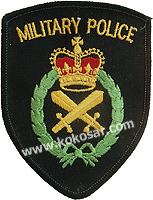
Pripadnici vojne policije nose na kapama oznaku koja se sastoji od ukrštenih mačeva okruženih vijencem na čijem se vrhu nalazi kraljevska kruna. To je jedan od dva znaka australske vojske koji na sebi nemaju nikakav natpis i zlatne je boje. Ljubičasta beretka se nosi uz sve uniforme, osim radne i kada su na paradi sa drugim korpusima. Na paradi se nosi Slouch šešir sa oznakom vojne policije na prednjoj strani i "Izlazeće sunce" znak australske vojske na uzdignutom obodu šešira. Na radnoj uniformi (field) se nosi kapa slična onoj američkih marinaca i na njoj se ne nose nikakve oznake. |
||
 |
 |
 |
| CAP BADGE | COLLAR BADGE | SLEEVE PATCH |
| Oznaka za kape | Oznaka za revere | Oznaka za rukave |
|
All MP's wear the same hat badge. It consists of crossed swords within a circular wreath and is topped with a Queens crown. It is one of only two badges in the Australian Army without writing on it and is gold in color. The Corps beret color is scarlet and is worn with all uniforms except in the field or on a parade with other Corps. The parade headdress for those parade occasion is a Slouch Hat with the left side up (Grade 1,as depicted in many movies) with the MP badge at the front of the head band and the Rising Sun (Australian Army badge) on the raised brim. In the field DPCU hats, similar to those worn by US Marines, are used without any embellishments or patches. |
||
|
ROYAL AUS.ELECTRICAL & MECHANICAL ENGINEERS KRALJEVSKI AUST. INŽINJERCI |
||
 |
||
|
4/19 PRINCE OF WALES LIGHT HORSE LAKA KONJICA PRINCA OD WALES-a |
||
 |
||
|
4/19 PWLH is a reserve regiment which has recently been re-rolled with modified Landrovers as part of the Light Cavalry restructure of the reserve component of the RAAC. Unit motto is "Ich Dein" (I Serve). The 4th/19th Prince of Wales’s Light Horse has a long and proud history. As the name implies, the origin of the Regiment is in 3 separate organisations, the 17th Prince of Wales’s Light Horse, the 19th Yarrowee Light Horse and the 4th (Ex 20th) Corangamite Light Horse. The amalgamation which occurred in 1948 is a relatively recent change in the history of the three Regiments. Today the Regiment is based in Melbourne and has two sabre squadrons, one in Gippsland and one in Melbourne, with a troop in Kyneton. The regiment is proud to have been granted the Freedom of Entry to 4 cities of Melbourne, Kyneton, Traralgon and Sale. |
||
|
ROYAL AUSTRALIAN ENGINEERS KRALJEVSKI AUSTRALSKI INŽINJERCI |
||
 |
 |
|
| CAP BADGE | CAP BADGE | |
| Oznaka za kape | Oznaka za kape | |
|
The Royal Australian Engineers (RAE) is a Corps of the Australian Army (although the word corps does not appear in their name or on their badge). The Corps was formed by the amalgamation of the various engineer corps of the States and territories of Australia. The motto of the Royal Australian Engineers is Ubique (Everywhere). Foundation day is 1st July 1902, and in present days Corps have 8 regular regiments. The Corps provides combat engineering, construction and other technical support to the Australian Defence Force. One of the objectives of the corps is mobility and counter mobility. That is providing mobility to friendly forces while denying movement to enemy forces. Engineers are able to conduct tasks including penetrating minefields, locating and disarming booby traps, purifying water and building roads and bridges. |
||
ON TOP
 NA VRH
 |
||