
| ROYAL THAI ARMED FORCE |
| KRALJEVSKE ORUŽANE SNAGE TAJLANDA |
|
|
 |
 |
 |
 |
|
Kraljevske Tajlandske oružane snage (Tajlandski: Kongthap Thai) je naziv vojske Kraljevine Tajland. Oružane snage se sastoje od Kraljevske Kopnene vojske, Kraljevske mornarice, Kraljevske avijacije, Kraljevskog marinskog korpusa te paravojnih snaga. Sve zajedno broje oko 360 000 pripadnika. Oružanim snagama zapovijeda, nominalno, Njegovo kraljevsko visočanstvo Kralj Bhumibol Aduyadej (Rama IX). Vojskom upravlja Ministarstvo odbrane na čijem se čelu nalazi Ministar koji je član Vlade. Direktno zapovijedanje je u rukama komandanta obrambenih snaga Tajlanda. Po Ustavu Kraljevine, služenje u oružanim snagama je obaveza svih sposobnih stanovnika. Ipak, služe samo muškarci, stariji od 21. godine koji nisu prošli kroz dobrovoljnu vojnu obuku i koji su "izvučeni" nasumice u procesu regrutacije. Oni koji su dobrovoljno prošli vojnu obuku služe 18 mjeseci, a izvučeni u postupku novačenja (regrutacije) služe 24 mjeseca. |
||
|
PARACHUTE WINGS PADOBRANSKA KRILA |
||
 |
||
| MASTER | ||
| Majstor padobranac | ||
 |
 |
 |
| BASIC | BASIC | |
| Padobranac sa osnovnom obukom | Padobranac sa osnovnom obukom | |
 |
 |
|
| RIGGER | ||
| Slagač padobrana | ||
|
The Royal Thai Armed Forces (Thai: Kongthap Thai) is the name of the military of the Kingdom of Thailand. It consists of the following branches: Royal Thai Army, Royal Thai NAvy, Royal Thai Marine Corps, Royal Thai Air Force and other paramilitary Forces. Today the Royal Thai Armed Forces comprises about 306,600 personnel. The Head of the Thai Armed Forces is His Majesty King Bhumibol Aduyadej (Rama IX), however this position is only nominal. The Armed Forces is managed by the Ministry of Defense, which is headed by the Minister of Defence (a member of the Cabinet) and commanded by the RTAF HQ, which is headed by the Chief od Defence Forces of Thailand. According to the Kingdom-s Constitution, serving in the Armed Forces is a duty of all Thai citizens. However only males over the age of 21 who have not gone through reserve training are subjected to a random draft. Those chosen randomly are subjected to twenty-four months fulltime service, while volunteers are subjected to eighteen months service, depending on their education. |
||
|
ROYAL THAI AIR FORCE KRALJEVSKA TAJLANDSKA AVIJACIJA |
||
 |
 |
|
| PARACHUTE FREE FALL WING BADGE | ? | |
| Padobranskkrila - slobodni skok (pad) | ||
|
ROYAL THAI AIR FORCE KRALJEVSKA TAJLANDSKA AVIJACIJA |
||
|
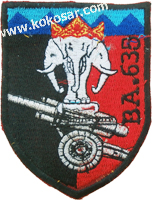
Oznaka BA 635 odnosi se na Bataillon Artillerie 635 (Artiljerijski bataljon 635), tajnu tajlandsku vojnu jedinicu angažiranu u tajnom ratu CIA-e u Laosu početkom 1970-ih. Osnovan u proljeće 1971. godine, BA 635 bio je prvi artiljerijski bataljon iz sastava operacije „Unity” upućen u Laos. Sastojao se od približno 20 oficira privremeno raspoređenih iz Kraljevske tajlandske vojske (RTA) i 380 dobrovoljaca obučenih u Artiljerijskom središtu RTA-e u Kokethiemu. Bataljon je bio opremljen baterijama haubica kalibra 105 mm i 155 mm (po četiri oruđa svaka), uz samostalne centre za usmjeravanje paljbe i specijaliziranu zaštitnu četu. Za razliku od uobičajenih snaga za statičnu obranu, BA 635 bio je ustrojen za mobilna djelovanja. Po dolasku u bazu gerilaca naroda Hmong u Long Tiengu, preuzeli su položaje baza za vatrenu podršku (FSB), poput FSB Zebra i FSB Tiger, kako bi se suprotstavili velikim ofenzivama Sjevernog Vijetnama. |
||
 |
||
|
BA 635 refers to Bataillon Artillerie 635 (Artillery Battalion 635), a clandestine Thai military unit deployed during the CIA's secret war in Laos in the early 1970s. Formed in the spring of 1971, BA 635 was the first "Unity" artillery battalion sent to Laos. It consisted of roughly 20 officers seconded from the Royal Thai Army (RTA) and 380 volunteers trained at the RTA Artillery Center at Kokethiem. The battalion was equipped with both 105mm and 155mm howitzer batteries (four tubes each), along with independent fire direction centers and a specialized security company. Unlike standard static defense forces, BA 635 was designed for mobile operations. Upon arriving at the Hmong guerrilla base of Long Tieng, they took over Fire Support Bases (FSBs) like FSB Zebra and FSB Tiger to counter major North Vietnamese offensives. |
||
ON TOP
 NA VRH